
SumerSystems unveils SumerOS orchestration platform for space-based computing
Nov 26, 2026
SumerSystems Corp. has unveiled SumerOS, a patent-pending orchestration platform that makes thermal, radiation, energy, network and storage conditions first-class inputs to workload decisions in orbit. The platform introduces a Physical State Vector for each node and is available as a demonstration.
Sacramento, United States, November 26, 2026 -- SumerSystems introduces SumerOS for orbital computing
SumerSystems Corp. today unveiled SumerOS, a patent-pending orchestration platform designed for space-based computing. The platform is available immediately as a demonstration environment. SumerOS addresses the challenge of managing computing resources in orbit, where environmental factors such as thermal conditions, radiation, energy availability, network connectivity and storage capacity critically affect performance and reliability.
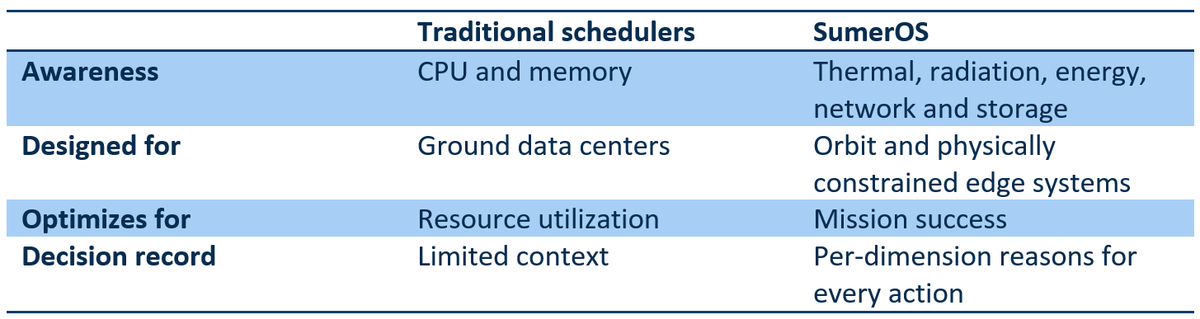
As satellites become more autonomous and data-intensive, traditional scheduling approaches built for terrestrial data centers are inadequate. SumerOS introduces a Physical State Vector for each computing node, treating physical conditions as first-class inputs to every workload placement decision.
Background: limitations of terrestrial schedulers in space
Existing schedulers allocate CPU, memory and storage while assuming stable power and cooling infrastructure. In orbit, these assumptions fail. A satellite may have ample processing capacity but face overheating risk, imminent eclipse, or communication gaps. These dynamic conditions require a new approach to resource management.
SumerOS maintains a five-dimensional view of each node's readiness across thermal, radiation, energy, network and storage dimensions. This allows operators to understand why a node is selected, excluded or flagged, rather than relying on a single health score.
How SumerOS works
The platform can be compared to air-traffic control for computers, where capacity, environmental limits and operating windows are all considered. SumerOS ranks eligible nodes against workload requirements, excludes nodes in critical states, and selects from five operational responses: placing new workloads on suitable nodes, migrating workloads from stressed nodes, replicating critical work for redundancy, throttling demand to protect margins, and deferring non-critical work to better windows. Every decision is logged with reasons, providing an explainable record.
"For sixty years we have asked how much compute we can launch into orbit. The better question is how intelligently we can use it once it is there," said Ash Sumer, Founder and CEO of SumerSystems. "SumerOS is the first platform built around a simple idea: the computer should understand the physics it lives in. When a satellite knows its own heat, power, radiation and link conditions, it can keep critical work running instead of waiting for something to go wrong."
Patent and market position
SumerSystems has filed a provisional patent application titled "Space-Native Distributed Computing Infrastructure: System and Methods for Orbital Computing, Storage, Networking, Thermal Management, and Autonomous Resource Orchestration." The application covers physical-state-aware scheduling, thermal-aware workload placement, radiation-aware execution, eclipse-aware energy orchestration, autonomous workload migration, orbital compute orchestration and space-air-ground resource management.
The company is entering a market where others focus on connecting to space or sensing from it. SumerOS is built for computing in space, providing a foundation for the emerging orbital compute ecosystem.
Demonstration and early access
The SumerOS demonstration environment combines live orbital data from CelesTrak with simulated spacecraft telemetry. It includes a Command Center for fleet posture and decisions, a Digital Twin for node-level exploration, Mission Control for fleet oversight, a Scenario Simulator for testing thermal events, eclipse entry, radiation events and communication interruptions, and an Executive Dashboard for leadership visibility.
The development roadmap advances SumerOS toward calibrated physical forecasting, policy-controlled autonomy with human approval and override, and hardware-in-the-loop pilots, so that action authority expands only as test evidence grows. SumerSystems is inviting satellite manufacturers, operators, Earth observation providers, defense contractors and orbital infrastructure companies to join its early-access program. Engagements range from focused evaluation projects to engineering and integration pilots.
"Every constellation operator we talk to wants more capability from the hardware already in orbit," Sumer added. "SumerOS gives them a path to get it, with the transparency and safeguards that mission-critical systems demand."
Long-term vision: Orbital Compute Network
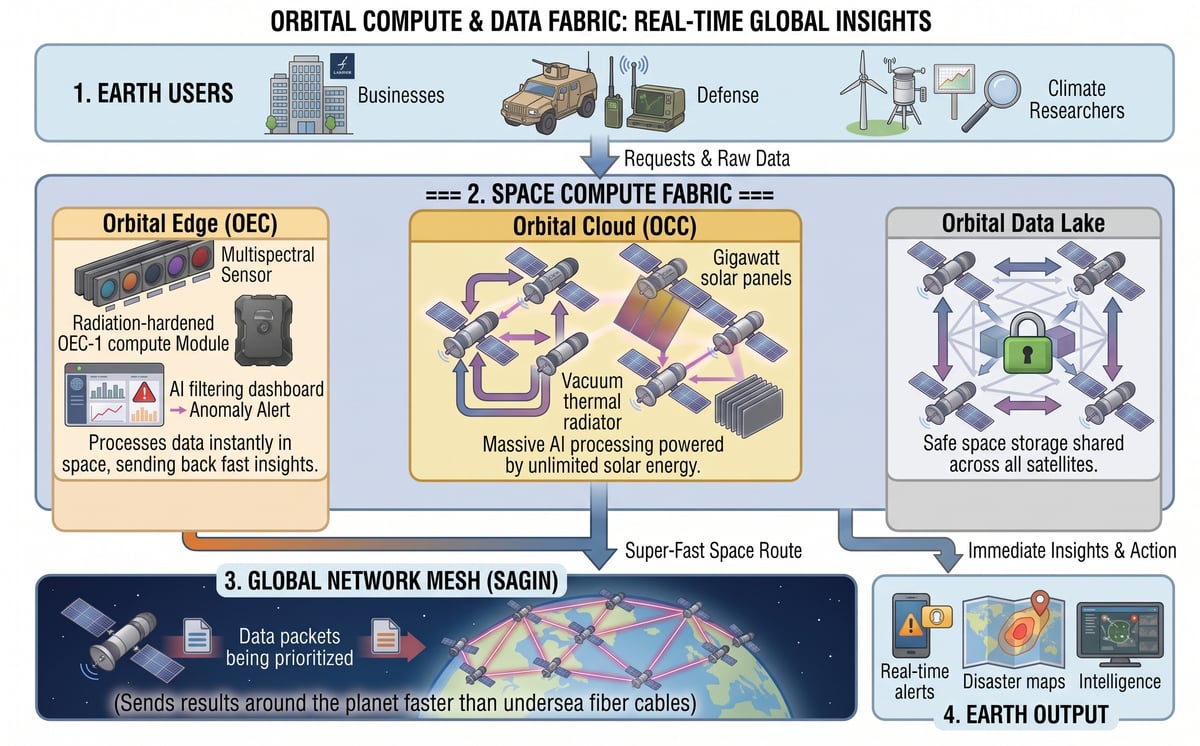
SumerOS is the first building block of SumerSystems' long-term vision: an Orbital Compute Network that brings AI inference, data storage and high-speed routing to Low Earth Orbit. Spanning Orbital Edge Computing, an Orbital Data Lake, Orbital Cloud Computing clusters and Space-Air-Ground Integrated Networking, the network is designed to run under one scheduling authority, with SumerOS as its control plane. Beyond orbit, the same physical-state-aware approach applies to remote edge sites, telecommunications networks, autonomous defense systems and energy-constrained data centers.
About SumerSystems
SumerSystems, Inc. is developing SumerOS for future distributed computing infrastructure, beginning with orbital use cases and extending toward terrestrial edge and physically constrained systems. Founded by Ash Sumer, whose background spans AI systems, anomaly detection, cloud architecture, cybersecurity and enterprise SaaS, the company is building the software layer that will let computing infrastructure understand and adapt to the physical world around it. Learn more at www.sumersystems.com.
Media Contact
Ash Sumer, Founder and CEO, SumerSystems Corp.
Email: [email protected]
Web: www.sumersystems.com
Forward-looking statements: This release contains forward-looking statements about SumerSystems' products, roadmap and plans. SumerOS demonstration capabilities use simulated telemetry, and planned capabilities remain subject to development, testing and validation. Actual results may differ materially.
Contact Info:
Name: Ash Sumer
Email: Send Email
Organization: SumerSystems Corp.
Website: https://www.sumersystems.com
Release ID: 89210986
If there are any problems, discrepancies, or queries related to the content presented in this press release, we kindly ask that you notify us immediately at [email protected] (it is important to note that this email is the authorized channel for such matters, sending multiple emails to multiple addresses does not necessarily help expedite your request). Our responsive team will be available round-the-clock to address your concerns within 8 hours and take necessary actions to rectify any identified issues or support you with press release takedowns. Ensuring accurate and trustworthy information is our unwavering commitment.
More News

'Indian IT's next big test is getting AI economics right,' says former GitHub CEO Thomas Dohmke
The emergence of AI agents is prompting Indian IT services companies to reconsider their business models. Experts suggest that firms must focus on the economics of AI rather than just deploying coding talent. Proper knowledge and design are crucial to avoid wasted expenditures on AI implementations, leading to significant savings. Dohmke emphasizes the potential for India to create notable global technology companies with the right support.



Bengal's legacy needs a Gen Z makeover to power its economic future
Faced with the pressing task of economic rejuvenation, West Bengal is striving to retain its youth and attract much-needed investment. During the Economic Times Bengal Ascends event, experts pointed out that the state's traditional economic identity requires transformation. They advocated for improved career opportunities and infrastructure, emphasizing collaboration with micro, small, and medium enterprises to cultivate a supportive investment climate and ensure the region’s prosperous future.

Bengal needs tech push, talent return to become global business hub, industry leaders say
Industry leaders at The Economic Times Bengal Ascends summit emphasized the need for West Bengal to enhance its technology ecosystem. They noted that improving infrastructure and talent acquisition could position the state as a hub for global services. Key investments, such as Amul's dairy plant expansion, could foster economic growth and benefit local farmers. The role of artificial intelligence in various sectors was also a focal point of discussion.

Ukraine says it struck a major Russian air base, damaging five planes
Ukrainian forces conducted a successful strike on the Savasleyka air base in Russia's Nizhny Novgorod region, damaging five military aircraft. This action is part of ongoing efforts to weaken Russia's military capabilities amid escalating conflict. Recent high-profile attacks also targeted Russian ships and infrastructure, illustrating Ukraine's aggressive response. Ukrainian Defense Minister Yevhenii Khmara reported hunting down numerous Russian ballistic-missile launchers used in attacks.

ET Bengal Ascends: Can Kolkata become the economic engine of eastern India? Industry leaders spell out what the state needs
Political alignment between West Bengal and the Centre is fostering infrastructure development and industrialisation in the state. Key discussions highlight land availability, execution speed, and nurturing first-generation entrepreneurs as crucial factors for growth. Industrialists emphasize the need for Kolkata to be positioned as the economic hub of the East to attract investments. Additionally, establishing trust and overcoming negative perceptions of the state are both essential elements.

Alice Huang-linked firms listed $270 million in AI servers in China, records show
Alice Huang's connections have helped finance up to 764 AI servers in China valued at around $270 million. Her previous company, Megaspeed, faces US restrictions on technology exports to China. Century Litong, linked to Huang, has secured financing for numerous powerful computing servers located in Shanghai. The hardware arrangements reflect ongoing challenges for Chinese technology firms to obtain essential computing resources.

ET Bengal Ascends: 'We invite businesses to partner govt in industrialisation drive,' says Industries Minister Tapas Roy
West Bengal's minister Tapas Roy stated that the government is focused on revitalizing the state's industrial sector. Significant investments are expected from domestic and foreign sources, promoting long-term economic growth. New policies covering industrial land and investment incentives have been introduced to attract manufacturers. The state aims to be a leading industrial hub by 2031, emphasizing sustainable development. Meetings with international investors reflect growing interest in West Bengal's industrial prospects.
Jensen Huang admits "terrible mistakes", apologises to employees over code of conduct violations in first address after Nvidia comeback
Jensen Huang, the chief executive of Nvidia, acknowledged making terrible mistakes in a recent meeting. He expressed regret for his personal misconduct, which impacted his family and colleagues. Huang stated that he is undergoing therapy while his actions led to his resignation earlier this month. Following an internal investigation, Nvidia's board reinstated Huang, stating it was in the company's best interest.
YOUR NEWS, OUR NETWORK.
Do you have Great News you want to tell the world?
Be it updates about your business or your community, you can make sure that it’s heard by submitting your story to our network reaching hundreds of news sites across 6 verticals.