
India's Bhashini and Chile's SITIA Lead AIFOD Ranking of Government AI Procurement Transparency
Nov 25, 2026
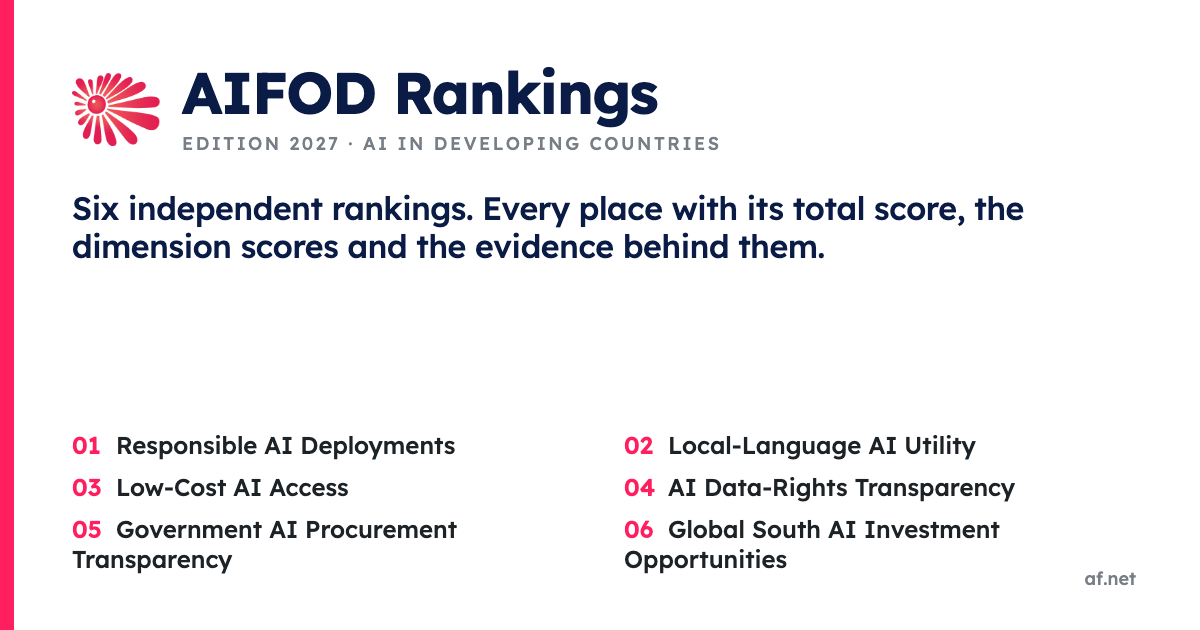
India places four projects in the top ten and Chile three; how suppliers are chosen and how citizens' data is protected are the least disclosed
Vienna, Wien Nov 25, 2026 (Issuewire.com) - Governments across the Global South are buying AI for courts, hospitals, schools and police. The Government AI Procurement Transparency Ranking, published by the AI for Developing Countries Forum (AIFOD), asks how much of each purchase the public can actually see: why it was bought, how the supplier was chosen, what safeguards apply and what happened next.
AIFOD assessed 72 named public AI tenders, contracts and pilots across Africa, South Asia, South-East Asia, the Middle East, Latin America and the Pacific, and ranked 49. India's Bhashini language platform placed first with 80.2 out of 100. Chile's SITIA licence-plate system placed third (76.2) and the Supreme Court of the Philippines fourth (75.0).
The top ten:
- Bhashini (Digital India BHASHINI Division, Ministry of Electronics and IT, India), 80.2. A national platform for machine translation, speech recognition and text-to-speech in India's 22 scheduled languages; it hosts more than 350 language models. Highest-scoring dimension: needs and procurement documents published (88).
- Bhashini system-integrator tender (India), 76.6. The 2024 request for empanelment publishes its qualification criteria and a 75-out-of-100 technical pass mark. It requires full source code to be handed over, a third-party security audit by a CERT-In-empanelled agency, and storage of sensitive user data in India. Highest-scoring dimension: needs and procurement documents published (90).
- SITIA (Undersecretariat for Crime Prevention, Chile), 76.2. Licence-plate recognition that flags vehicles wanted by police, mainly stolen ones. Its operator published a data-lifecycle report, which counted 25,592 detections in July 2024, and an algorithmic impact self-assessment. Highest-scoring dimension: needs and procurement documents published (85).
- AI court transcription (Supreme Court of the Philippines), 75.0. Speech-to-text for court stenographers, bought from SoftwareOne Philippines by direct contracting. The court published the three-year contract, worth PHP 33.1 million, and stenographers remain accountable for the final transcript. Highest-scoring dimension: needs and procurement documents published (78).
- AI chest X-ray reading (National Health Security Office, Thailand), 74.6. Added to Thailand's universal coverage scheme in July 2025, with up to 55 million baht for fiscal 2025 and a pilot in 167 public hospitals. The Inspectra CXR software was developed by Perceptra and KMUTT with Siriraj Hospital. Highest-scoring dimension: local team participation and capacity building (90).
- School Admission System (Ministry of Education, Chile), 72.8. A central algorithm that assigns pupils to public and subsidised schools under the School Inclusion Act; Chile's Transparency Council published an evaluation of it in 2026. The system is under legislative reform. Highest-scoring dimension: local team participation and capacity building (92).
- ChileCompra language-model tender (Chile), 72.4. Tendered openly in August 2025 and awarded in January 2026: language models that screen about 200,000 purchases a year against 20 compliance rules, with skills transferred to ChileCompra's own staff. Highest-scoring dimension: needs and procurement documents published (88).
- Digi Yatra (India), 72.4. Facial-recognition boarding at Indian airports, launched in December 2022 and run by the not-for-profit Digi Yatra Foundation. Highest-scoring dimension: needs and procurement documents published (88).
- ALICE (Office of the Comptroller General, Brazil), 72.3. An in-house tool that screens procurement notices for irregularities. The comptroller recorded R$9.7 billion of tenders suspended or cancelled after its alerts between 2019 and June 2022. Highest-scoring dimension: local team participation and capacity building (88).
- AIKosh (IndiaAI Mission, India), 71.3. A public repository of more than 16,000 datasets and 350 AI models, according to the Indian government in October 2026. Highest-scoring dimension: data and rights safeguards (85).
What the ranking shows. Across the 49 ranked projects, the weakest areas were data and rights safeguards, with an average score of 44 out of 100 and ten projects publishing no evidence at all, and supplier selection, at 45, with nine projects publishing nothing on how the supplier was chosen. Local team participation scored highest, at 76. Governments are increasingly open about why they buy AI; they are much less open about how the supplier was picked and how citizens' data is protected.
Each project was scored equally on five questions: were the need and the procurement documents published; how was the supplier selected; what data and rights safeguards apply; were local teams involved and trained; and were results, problems and appeals disclosed. The ranking covers specific purchases and pilots, not countries or governments as a whole.
"Governments are buying AI faster than they are explaining it," said Bernardo Cartoni, Chair of the AIFOD Drafting Committee. "The projects at the top show that publishing the tender, the contract and the results is possible, in New Delhi, Santiago and Manila alike."
The ranking reflects the values AIFOD works by: an independent voice for the Global South, bridges between governments and industry, collaboration rather than confrontation, and ideas judged on merit rather than status. AIFOD's work is aligned with the UN Sustainable Development Goals, and this ranking speaks to Goal 16, Peace, Justice and Strong Institutions. Public bodies, multilateral organisations and suppliers are invited to the AIFOD Nairobi Summit, held 17-19 February 2027 at the United Nations Office at Nairobi; applications are open at af.net/nairobi.
Public buyers looking for trustworthy small suppliers can also check FAIR, AIFOD's certification for small AI companies in developing markets. It gives a supplier a public, verifiable rating it can cite in tenders, assessed on four equal pillars (respectful entry, shared development, data stewardship and sustainable impact) and decided by the FAIR Certification Committee. Applying is free, certified systems are listed in the public FAIR Registry at fair.af.net, and FAIR status appears in ranking profiles as a fact but never adds points.
About the ranking. Scores are based on public documents and were checked by independent reviewers. Public bodies may submit corrections to [email protected] at any time. AIFOD funds the research itself; no organisation pays for inclusion or previews results. Full scores, evidence and sources are published at af.net/rankings under a CC BY 4.0 licence.
About AIFOD. The AI for Developing Countries Forum (AIFOD), registered in Switzerland and Austria, promotes the ethical and inclusive use of AI across the Global South through certification, capacity sharing, technology transfer and international cooperation. It has more than 7,300 members in over 150 countries. Its next summit takes place 17-19 February 2027 at the United Nations Office at Nairobi.
Source :AI for Developing Countries Forum (AIFOD)
This article was originally published by IssueWire. Read the original article here.
More News


India poised to become a major global space power, says Skyroot CEO Pawan Chandana
Pawan Kumar Chandana emphasized India's potential in the global space sector during the 45th Vikram Sarabhai Memorial Lecture. He highlighted that India's first privately developed rocket, Vikram-1, marks the beginning of a larger ecosystem for private space companies. Chandana predicted that the next decade would witness rapid technological advancements surpassing the achievements of the past 200 years.

FSSAI directs States to step up inspections of packaged drinking water brands
The directive also requires authorities to upload inspection details, samples collected and test reports to a central food safety compliance system.

Maharashtra Cabinet approves free foodgrains for 42.30 lakh farmers, Rs 5,548 crore for Narmada-Tapi project
The Maharashtra Cabinet on Wednesday approved free foodgrains for 42.30 lakh farmers, ₹5,548 crore for the Narmada-Tapi Valley Diversion Project and a draft bill to regulate private aided schools, among 14 decisions taken at the meeting.

India-UK investment treaty talks stall, pact unlikely soon, officials say
The prospect of India pursuing a bilateral investment treaty with the UK appears grim, primarily because of enduring disputes related to taxation and arbitration. Talks have hit a snag, with both countries entrenched in contrasting views on investor protection and sovereignty. Future discussions will divert from the investment treaty, concentrating on economic dialogues instead.
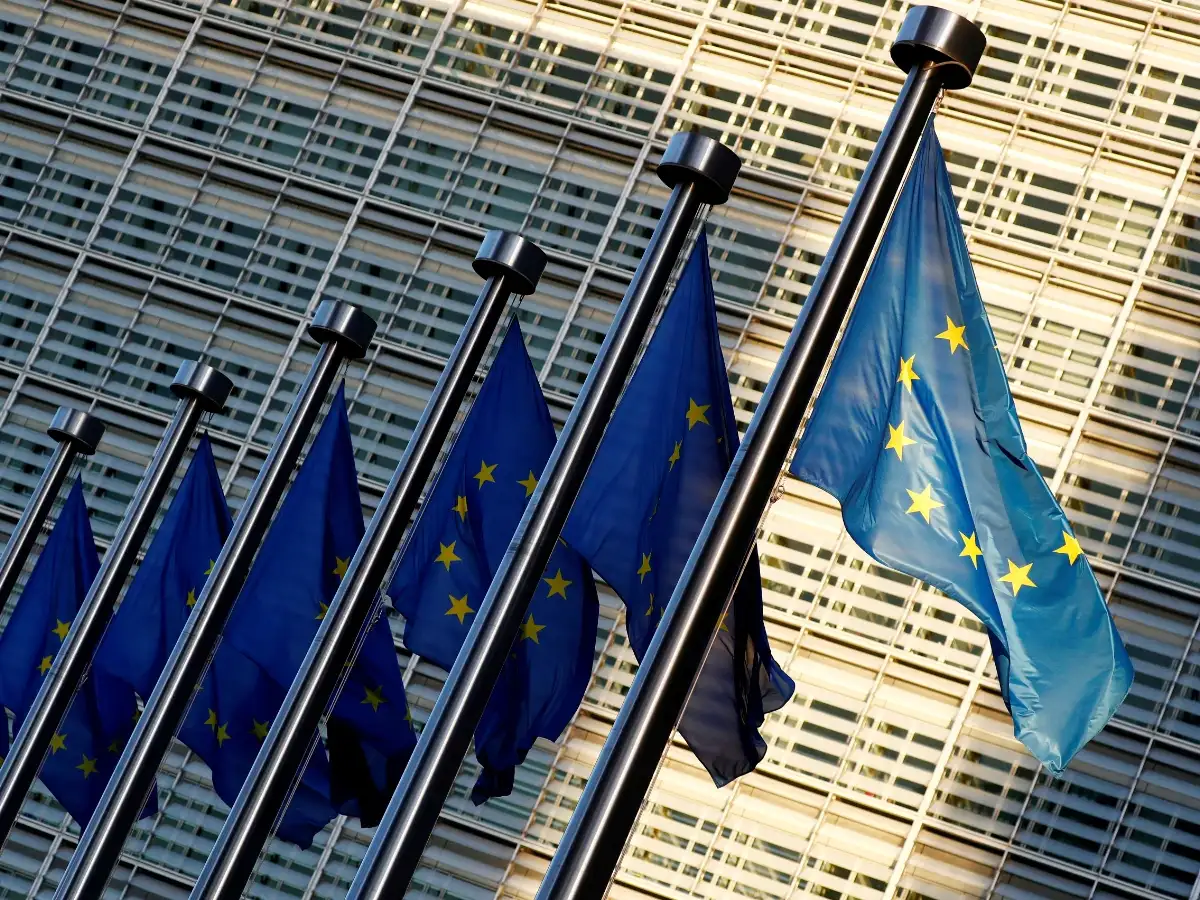
US must respect 15% tariff ceiling for EU, European Commission says
In a recent statement, the European Commission stressed that any new US tariffs must not exceed the agreed 15% limit on European Union goods. This comes after the Trump administration suggested imposing further Section 301 tariffs. The Commission also voiced disappointment regarding insufficient collaborative efforts to mitigate global overcapacity in the market, firmly asserting that Europe is not to blame for these structural challenges.

Gukesh Vs Sindarov World Chess Championship Highlights: Gukesh, Sindarov Play Out Draw In Game 2
Follow LIVE updates from the World Chess Championship clash between Gukesh and Javokhir Sindarov. Get move-by-move coverage, key moments and results.

Gukesh settles for second straight draw against Sindarov in World Chess Championship
In Game 2 of the World Chess Championship, D Gukesh and Javokhir Sindarov ended with an early draw. The match took place in Geneva and lasted 20 moves. Gukesh, playing with white, used the London System to start the game. Both players remained cautious, which led to a stalemate situation by the end of the match. They will compete again on Thursday to try and secure a win.




US crude inventories rise by 1.1 million barrels, below market expectations
U.S. crude and fuel inventories saw an increase during the week ending November 20. Crude inventories rose by 1.1 million barrels, reaching a total of 418.9 million barrels. Gasoline stocks also increased, recording a rise of 1.7 million barrels to 217.7 million barrels. In addition, refinery crude runs and utilization rates improved during the same period. Distillate stockpiles experienced a smaller increase, rising by 715,000 barrels to 105.6 million barrels.
YOUR NEWS, OUR NETWORK.
Do you have Great News you want to tell the world?
Be it updates about your business or your community, you can make sure that it’s heard by submitting your story to our network reaching hundreds of news sites across 6 verticals.