
Voters cast ballots in a Bangladesh election marred by violence and an opposition boycott
Jan 7, 2024
Polls have opened in Bangladesh as voters cast their ballots in an election fraught with violence and a boycott from the main opposition party
DHAKA (AP) — Voters in Bangladesh cast their ballots Sunday as polls opened in a parliamentary election fraught with violence and a boycott from the main opposition party, paving the way for
Prime Minister Sheikh Hasina
and her Awami League to seize a fourth consecutive term.Authorities said at least 18 arson attacks were reported across the country since late Friday, with 10 of them targeting polling places. Four people died Friday in an
arson attack on a passenger train
heading toward the capital, Dhaka. The incidents have intensified tensions ahead of the parliamentary elections that the opposition Bangladesh Nationalist Party and its allied groups said they would shun.Campaigning in the South Asian nation of 169 million has been marred with violence as at least 15 people have been killed in recent months. Hostilities reached a boiling point in late October after a massive rally in Dhaka by the BNP saw
clashes with police
.As the election neared, authorities blamed much of the violence on the BNP, who they accused of seeking to sabotage the election. On Saturday, detectives arrested seven men belonging to the BNP and its youth wing for their alleged involvement in the passenger train attack. The opposition party denied any role in the incident, and said they are being blamed by authorities who want to discredit their “peaceful and nonviolent movement.”
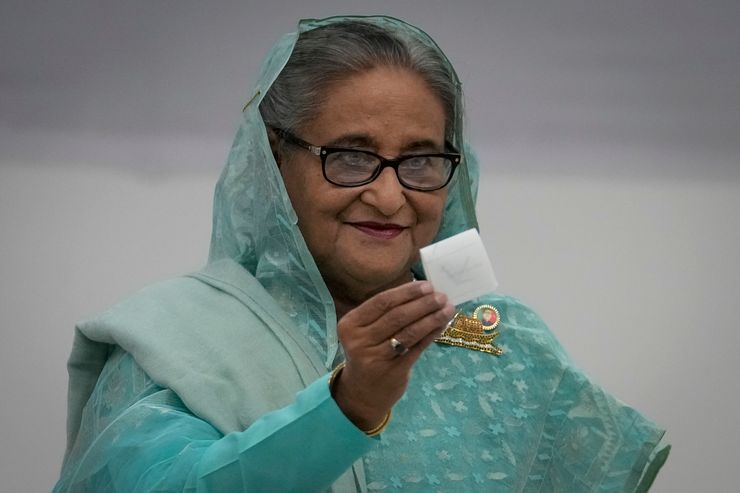
On Sunday morning, Hasina and her daughter voted amid tight security at Dhaka City College, as other citizens lined up outside to cast their ballots.
The 76-year-old Hasina, the country’s longest-serving leader and one of its most consequential, is widely expected to be reelected for a fifth overall term.
But a victory would come with a deeply contentious political landscape. The vote, like previous elections, has been defined by the bitter rivalry between Hasina’s Awami League and BNP, led by former Premier Khaleda Zia, who is ailing and under house arrest on corruption charges, which her supporters claim are politically motivated.
The two women ran the country alternatively for many years, cementing a feud that has since polarized the country’s politics and fueled violence around elections.
This year’s vote raised questions over the credibility of the polls when there are no major challengers to take on the incumbent.
Nearly halfway into voting hours, the turnout was 18.5%, according to the Election Commission Secretary Jahangir Alam.
Badshah Mia, 55, a rickshaw puller in Dhaka told The Associated Press that he wouldn't vote, given the limited choices, adding that the atmosphere didn’t exude that of “a fair election.”
Sakibul Hasan Chowdhury, a businessman, felt the same: “There is no opposition and no candidate of my choice. So how would I benefit from voting?”
Meanwhile, Habibur Rahman, 56, who owns a small business said he was voting for the ruling party candidate in his constituency but added that there didn't seem to be much crowd or a turnout.
Affan Bin Imran, a 19-year-old student, said he felt proud and excited to be able to cast his vote for the first time.
Critics and rights groups say the vote follows a troubling pattern, where the past two elections held under Hasina were sullied by allegations of vote-rigging — which authorities have denied — and another
boycott by opposition parties
.The government has rejected a monthslong demand by the BNP to have a neutral caretaker government administer Sunday's vote.
The government has defended the election, saying 27 parties and 404 independent candidates are participating. But with scores of those independent candidates from the Awami League itself, and mostly smaller opposition parties in the race, analysts say Hasina's win is near inevitable.
Michael Kugelman, director of the South Asia Institute at the Wilson Center, said none of those contesting would be able to mount much of a challenge to Hasina’s party. “The outcome is all but guaranteed, and that is that the Awami League will return (to power) again,” he said, noting that "Bangladesh’s democracy will be in an extremely precarious state once the election is done.”
The vote has also been called into question by
accusations of a sweeping crackdown
against the BNP. The party says about 20,000 of their members were jailed ahead of the vote on trumped-up charges, but the government disputed the figures and denied that arrests were made due to political leanings, saying the numbers of those arrested were between 2,000-3,000. The country’s law minister in an interview with the BBC said 10,000 were likely arrested.Abdul Moyeen Khan, a former minister and BNP leader, said the spate of arrests forced him and scores of other party members to go into hiding for weeks until candidacy nominations were halted. “It was the only way we could ensure our safety and carry on raising our voice (against the government)” he said.
“We are not boycotting an election — what we are boycotting is a fake and one-sided election that this government is carrying out,” Khan added.
Hasina is credited with transforming the economy of a young nation born out of war and making its garment sector one of the world’s most competitive. Her supporters say she has staved off military coups and neutralized the threat of Islamist militancy. And internationally, she’s helped raise Bangladesh’s profile as a nation capable of doing business and maintaining diplomatic ties with countries often at odds with each other, like India and China.
Yet her critics say her rise has risked turning Bangladesh into becoming a one-party state where democracy is under threat, as emboldened government agencies increasingly use oppressive tools to mute critics, shrink press freedoms and restrict civil society.
The global economic slowdown is also being felt in Bangladesh,
exposing cracks in its economy
that havetriggered labor unrest and dissatisfaction
with the government.In the capital, posters of Awami League candidates and the party’s boat symbol are ubiquitous, with images of Hasina plastered on numerous banners dotting the city.
After casting her ballot, Hasina dismissed concerns over the legitimacy of the vote, telling reporters she was accountable to the people and whether they accepted the election or not was what mattered to her.
“I’m trying my best to ensure that democracy should continue in this country,” Hasina added. “Without democracy, you cannot make any development.”
Polls were to be open for 8 hours across the country for some 119 million eligible citizens to vote in over 42,000 stations. Nearly 2,000 candidates were vying for seats in 299 constituencies out of 300, as the election in one constituency was postponed after an independent candidate died of natural causes.
About 700,000 security officials have been deployed to guard the polls and more than 120 foreign observers have arrived to monitor the vote, according to the Election Commission.
—
AP video journalist Al-Emrun Garjon contributed reporting.
MORE NEWS

China’s top swimmers enjoy record-breaking performances at national championships
Chinese swimmers showcased their strength in-depth with record-breaking performances by veterans and rising stars at the national championships in Beijing. As of Tuesday, swimmers had broken one world, six Asian and multiple national records. Zhang Yufei and Zhang Zhanshuo set Asian short-course records in the women’s 100m butterfly and men’s 800m freestyle, clocking 54.87 seconds and 7 minutes 28.61 seconds respectively to claim gold. The national event is the official selection trial for...
'Personal' Setback Behind Neeraj Yadav's Suicide? Police Reveals Startling Details
A reported fallout with a woman friend has emerged as a key angle in the investigation into Neeraj Yadav's death.

Three-Time Grand Slam Winner Ends Tennis Career With 1st-Round Defeat In Basel
Stan Wawrinka ended his 24-year professional tennis career following a first-round defeat at the Basel Open.

Thomas van Tonder Completes World-First Crossing Beneath Bloukrans Bridge
Thomas van Tonder completed a world-first crossing beneath Bloukrans Bridge, traversing 600 suspended monkey bars over 280 metres in 47 minutes and 37 sec.
Neeraj Yadav, Three-Time Asian Para Games Gold Medallist, Dies By Suicide
Para-athlete Neeraj Yadav has reportedly died by suicide after consuming poison.
Babus who call late meetings, delay files face scrutiny as cabinet secretary lists 12 types of secretaries
Cabinet Secretary T V Somanathan highlighted issues with bureaucratic efficiency at a recent performance review meeting. He presented a list of problematic behaviors affecting government productivity using cartoons. Somanathan emphasized the necessity of timely decision-making and better communication between ministries. Another topic addressed was the improper usage of ration cards by railway employees.

Delhi starts online liquor booking app: How to order favourite brands without waiting in queues, check process, outlet availability, and key rules
Delhi's latest initiative introduces an online liquor booking app, letting users select their favorite brands and make payments seamlessly. To streamline the process, residents have 48 hours to pick up their orders from one of the 208 designated shops. While home delivery isn’t an option, the app aims to eliminate long queues and enhance transparency.


1st batch of Agniveers retiring soon: What's the retirement money, career options and benefits they will get
By 2026, approximately 18,300 Agniveers will finish their service in the armed forces, marking a pivotal transition. To ease their shift into civilian life, numerous states have initiated job quotas specifically for ex-Agniveers across different uniformed services and police departments. These initiatives stem from the Agnipath scheme launched in June 2022, which focuses on enlisting younger individuals in military roles.
GST clarification on foreign investor brokerage offers sentiment boost, analysts say
The Indian government has clarified that brokerage paid by overseas clients may qualify as an export service. This could help foreign investors avoid the 18% goods and services tax on brokerage fees. Analysts suggest this clarification is sentimentally positive amid significant foreign outflows from Indian stocks. There is ongoing speculation regarding potential cuts in capital gains tax ahead of the federal budget.

'Copying China's manufacturing model may not pay off': Ashwini Vaishnaw hits back with ‘Cope harder’ remark, cites Rs 3 lakh crore PLI returns
Union Minister Ashwini Vaishnaw has hit back at criticism of India's mobile phone manufacturing strategy with a blunt “Cope harder” remark. Citing figures from the government's Production Linked Incentive (PLI) scheme, he said the government paid Rs 19,000 crore in incentives and collected Rs 25,000 crore in direct taxes, alongside Rs 3 lakh crore in GST. His response followed a Bloomberg Opinion video questioning India's iPhone manufacturing model, its dependence on imported components and the cost of government subsidies.